
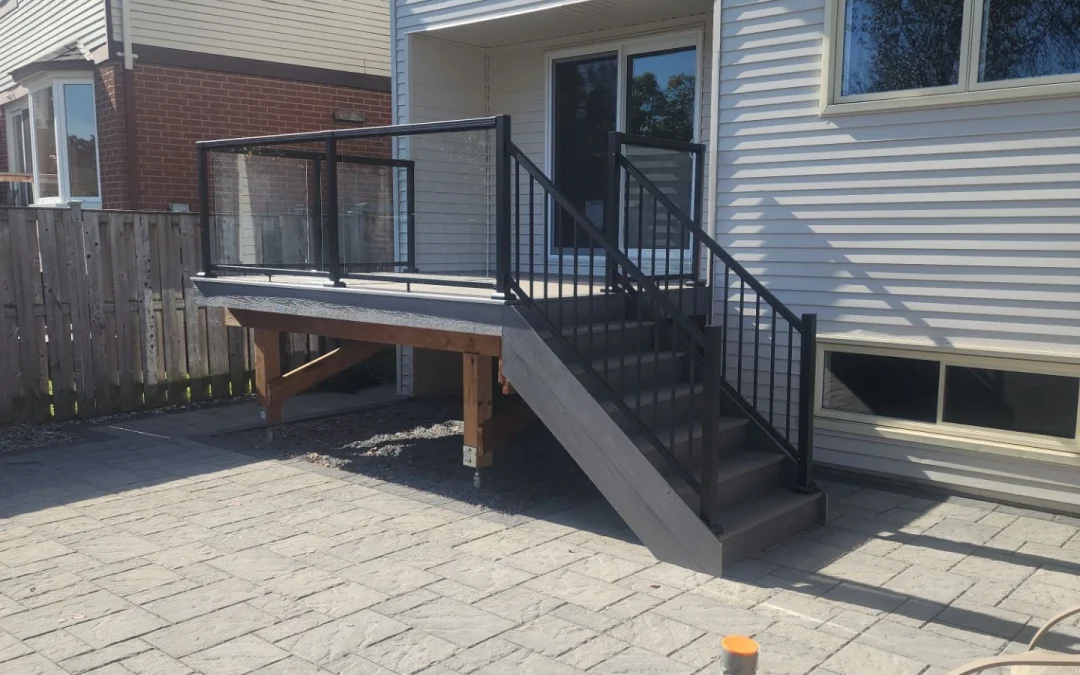
One of the most common questions Ottawa homeowners face when planning a new driveway is whether to go with interlock or poured concrete. Both are durable, both look great when freshly installed – but they perform very differently over the long term, especially in Ottawa’s climate.
This guide walks through the real differences so you can make the right call for your property.
The Core Difference: How Each Material Handles Ottawa Winters
Ottawa averages over 100 freeze-thaw cycles per year. That repeated cycle of freezing, expanding, thawing, and contracting is the single biggest stress test for any driveway surface – and it’s where interlock and concrete diverge most sharply.
Concrete is a rigid slab. When the ground beneath it moves – and in Ottawa’s clay-heavy soil, it will – concrete has nowhere to go. The result is cracking. Once a concrete slab cracks, the repair is visible and the structural integrity is compromised. Most Ottawa concrete driveways show significant cracking within 10 – 15 years.
Interlock is a flexible system. Individual pavers are set in sand and can shift slightly with ground movement without cracking. If frost heave does push a section out of alignment, the stones can be lifted, the base corrected, and the same stones re-laid. No visible patch, no structural damage.
Durability: Long-Term Performance in Ottawa Conditions
Both materials are durable when properly installed. The difference is what happens over time:
- Concrete is strong but brittle. Surface spalling (flaking caused by de-icing salts) is extremely common in Ottawa. Salt penetrates the surface, attacks the concrete matrix, and causes the top layer to break apart – typically starting within 5 – 10 years on a driveway that sees regular winter maintenance.
- Interlock handles de-icing products better. Individual pavers are factory-sealed or can be sealed after installation, and the joints allow water and salt to drain away rather than sitting on the surface.
Repairability
This is where the comparison isn’t close.
Concrete repairs are permanent and visible. A patched crack never matches the original pour in colour or texture. A section replacement is almost always obvious. Over time, a repaired concrete driveway looks like a patchwork.
Interlock repairs are invisible. Lift the affected stones, fix the base, re-lay the stones, re-sand the joints. If you’ve kept any leftover stone from the original installation (a good contractor will recommend this), there’s no visual difference whatsoever.
Maintenance Requirements
Concrete Maintenance
- Sealing every 2 – 3 years helps slow salt damage but doesn’t eliminate it
- Crack monitoring and patching as issues develop
- Avoid harsh de-icing salts where possible
- Power washing to remove staining
Interlock Maintenance
- Re-sanding joints every few years as polymeric sand settles or erodes
- Sealing every 3 – 5 years for optimal colour retention and weed resistance
- Occasional re-levelling of sections if settling occurs
- Power washing to maintain appearance
Both require ongoing maintenance. Interlock maintenance tends to be more predictable and less reactive – you’re topping up sand and sealing on a schedule, rather than responding to cracks as they appear.
Aesthetics and Curb Appeal
Concrete offers a clean, uniform look that suits certain architectural styles well. It can be stamped, coloured, or textured, though these finishes add cost and are more vulnerable to wear.
Interlock offers significantly more design flexibility – dozens of stone shapes, colours, textures, and patterns. Borders, inlays, and mixed-material designs are all achievable. For Ottawa homeowners who want a driveway that contributes to curb appeal rather than just fills the space, interlock gives more to work with. Browse some examples in our project portfolio to see what’s possible.
Installation Considerations
Concrete requires a cure time of typically 7 – 28 days before full use. Freshly poured concrete is also more vulnerable to damage during that window.
Interlock can typically be used immediately after installation, though the contractor may recommend waiting a day or two for the polymeric sand to fully set.
Side-by-Side Comparison
| Factor | Interlock | Concrete |
|---|---|---|
| Freeze-thaw performance | Excellent – flexible system moves with ground | Moderate – rigid slabs prone to cracking |
| Salt damage resistance | Good – joints drain salt and water away | Poor – de-icers cause surface spalling |
| Repairability | Excellent – individual stones replaceable invisibly | Poor – patches always visible |
| Design options | High – many shapes, colours, patterns | Moderate – stamped/coloured adds cost |
| Maintenance | Predictable and scheduled | Reactive – responds to cracks as they form |
| Usable after install | Immediately (or next day) | 7 – 28 day cure required |
| Upfront cost | Higher | Lower to moderate |
| Long-term value | Strong – repairable, durable, high curb appeal | Moderate – cracking reduces value over time |
Which Is Right for Your Ottawa Home?
For most Ottawa homeowners, interlock is the stronger long-term choice – particularly for driveways, where freeze-thaw stress and de-icing salt exposure are highest. The flexibility of the system, the repairability, and the design options make it a better fit for Ottawa’s conditions than a rigid concrete slab.
Concrete can still be the right call in certain situations – budget constraints, architectural style, or personal preference. But if longevity and low-maintenance ownership are priorities, interlock has the edge in Ottawa’s climate.
Frequently Asked Questions
Does interlock last longer than concrete in Ottawa?
Generally yes, when properly installed. The flexibility of an interlock system handles Ottawa’s freeze-thaw cycles better than a rigid concrete slab, and any damage that does occur can be repaired invisibly.
Can you put interlock over existing concrete?
Not typically recommended. Proper interlock installation requires excavation to the correct depth for a compacted granular base. Installing over an existing concrete slab compromises the base and leads to drainage issues and premature settling.
Is interlock more expensive than concrete in Ottawa?
The upfront installation cost for interlock is generally higher than concrete. However, when factoring in long-term maintenance, repair costs, and lifespan, many Ottawa homeowners find interlock offers better overall value. For more on what drives interlock pricing in Ottawa, see our dedicated guide.
How do I maintain interlock in Ottawa winters?
Use plastic shovels or snow blowers rather than metal blades that can chip paver edges. Sand is gentler than salt as a de-icer. Regular sealing and joint sand maintenance are the two biggest factors in keeping interlock looking good year after year.
Get Your Free Estimate Today
Considering an interlock driveway in Ottawa? Contact JAL Deck & Interlock for a free estimate. We serve Ottawa and surrounding areas including Stittsville, Carleton Place, Nepean, Barrhaven, and beyond.